

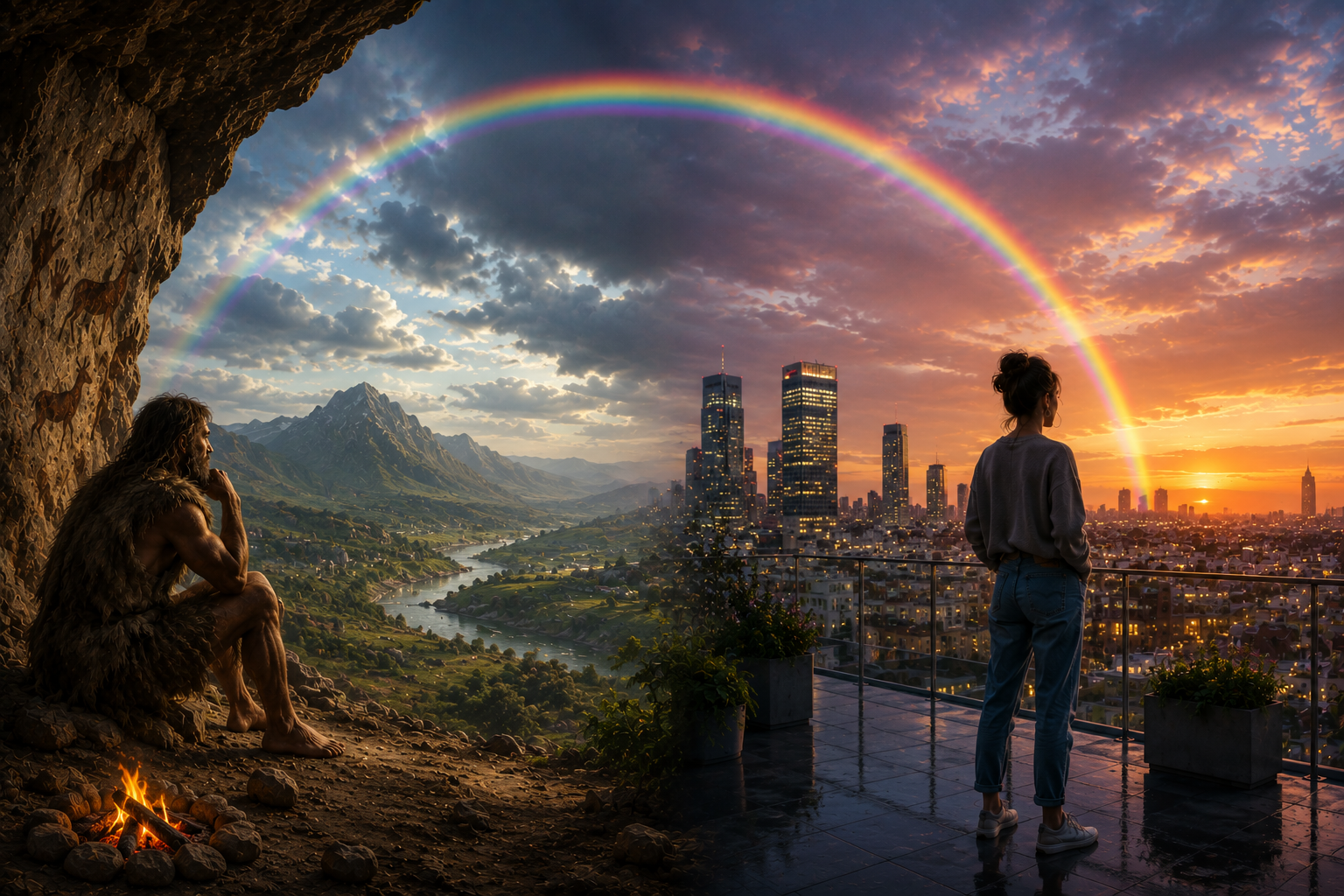
Every June, Pride Month returns with its rainbow flags, celebrations, and, inevitably, its controversies. Supporters see it as a celebration of inclusion. Critics often dismiss it as unnecessary, ideological, or disconnected from “real problems.”
But perhaps the discussion is being framed incorrectly.
What if diversity is not merely a moral principle or a political preference?
What if it is one of humanity’s greatest evolutionary advantages?
The Species That Survived by Being Different
Unlike most animals, humans are remarkably unfinished creatures.
A newborn horse can walk within hours. A human child requires years of care. Evolutionary biologists describe this characteristic as neoteny: humans retain juvenile traits longer than other species, creating an extended period for learning and social development.
This apparent weakness became one of our greatest strengths.
Because our children remained vulnerable for so long, survival depended on cooperation. Tribes, families, communities, and increasingly complex societies emerged not because humans were individually stronger than other species, but because they learned to depend on one another.
The human story is not the story of the strongest individual; it is the story of the most cooperative group.
Culture Evolves Faster Than Biology
Genetic evolution moves slowly. Cultural evolution moves at astonishing speed.
Anthropologist Joseph Henrich has argued that humanity’s real superpower is cumulative culture: our ability to accumulate knowledge across generations and build upon it.
Biologist David Sloan Wilson has explored how cooperation at the group level can become an evolutionary advantage. Historian Peter Turchin has shown how collective identities and social cohesion have often determined the rise and fall of civilizations.
Meanwhile, Yuval Noah Harari reminds us that much of human society exists because we can create shared stories and collective meanings.
In other words, humans adapted to changing environments not simply through better genes, but through better ideas.
And ideas thrive through diversity.
Diversity as an Evolutionary Portfolio
In finance, diversification reduces risk, in nature, biodiversity protects ecosystems.
Perhaps cultural diversity performs a similar function for civilizations.
Different perspectives generate different solutions. Different experiences create alternative ways of understanding problems. Minority viewpoints can become major innovations. What appears unusual in one generation may become essential in the next.
Humanity has repeatedly benefited from people who did not perfectly fit existing norms:
Artists, Scientists, Philosophers, Inventors, Migrants, Religious minorities, Social reformers.
Progress often arrives through difference, not despite it.
Beyond Tolerance
Too often, discussions about diversity are reduced to the language of tolerance.
Tolerance implies putting up with something.
But evolution suggests something more profound: diversity is not simply something to endure.
It is something to preserve.
This principle extends beyond ethnicity, nationality, or religion. It includes ideas, lifestyles, personalities, and yes, gender identities and sexual orientations.
Whether one approaches these topics from politics, religion, or philosophy, it is difficult to deny a simple historical fact:
Human societies have always contained diversity.
The existence of difference is not new: the visibility of difference is.
Pride and the Bigger Picture
Perhaps Pride Month can be understood not only as a social movement but as a reminder of a broader truth about our species:
Humans succeeded because we learned to transform differences into cooperation.
Because we exchanged ideas.
Because we created cultures capable of adapting faster than our biology ever could.
In a rapidly changing world – artificial intelligence, climate change, demographic shifts, and technological revolutions – adaptability may once again determine our future.
And adaptability has always been fueled by diversity.
Not because diversity guarantees success, but because uniformity guarantees fragility.
Maybe that is the real lesson Pride Month offers.
Not that everyone must think alike, but that humanity survives precisely because we do not.
Nature experiments through variation. Civilizations progress through diversity.
References and Further Reading
- David Sloan Wilson (2002). Darwin’s Cathedral Evolution, Religion, and the Nature of Society. University Of Chicago Press.
- Wilson, D. and Wilson, Edward O. (2007). Rethinking the Theoretical Foundation of Sociobiology. The Quarterly Review of Biology, 82(4), pp.327–348. doi:https://doi.org/10.1086/522809.
- Nowak, M.A. and Highfield, R. (2012). Supercooperators : altruism, evolution, and why we need each other to succeed. New York: Free Press.
- Henrich, J. (2015). The Secret of Our Success How Culture Is Driving Human Evolution, Domesticating Our Species, and Making Us Smarter. Princeton; Oxford Princeton University Press.
- Boyd, R. and Richerson, P.J. (1985). Culture and the evolutionary process. Chicago: University Of Chicago Press.
- Richerson, P.J. and Boyd, R. (2005). Not by genes alone : How culture transformed human evolution. Chicago: University of Chicago Press.
- Turchin, P. (2016). Ultrasociety : how 10,000 years of war made humans the greatest cooperators on Earth. Chaplin, Connecticut, U.S.A.: Beresta Books.
- Harari, Y.N. (2014). Sapiens : a brief history of humankind. London: Vintage Digital.
- Montagu, A. (1989). Growing Young. Praeger.
- Page, S. (2007). The Difference How the Power of Diversity Creates Better Groups, Firms, Schools, and Societies (New Edition). Princeton University Press.