

A Lesson from Hannah Fry
A few days ago, while mindlessly scrolling through TikTok, I came across a short video by one of my favorite science communicators, Hannah Fry.
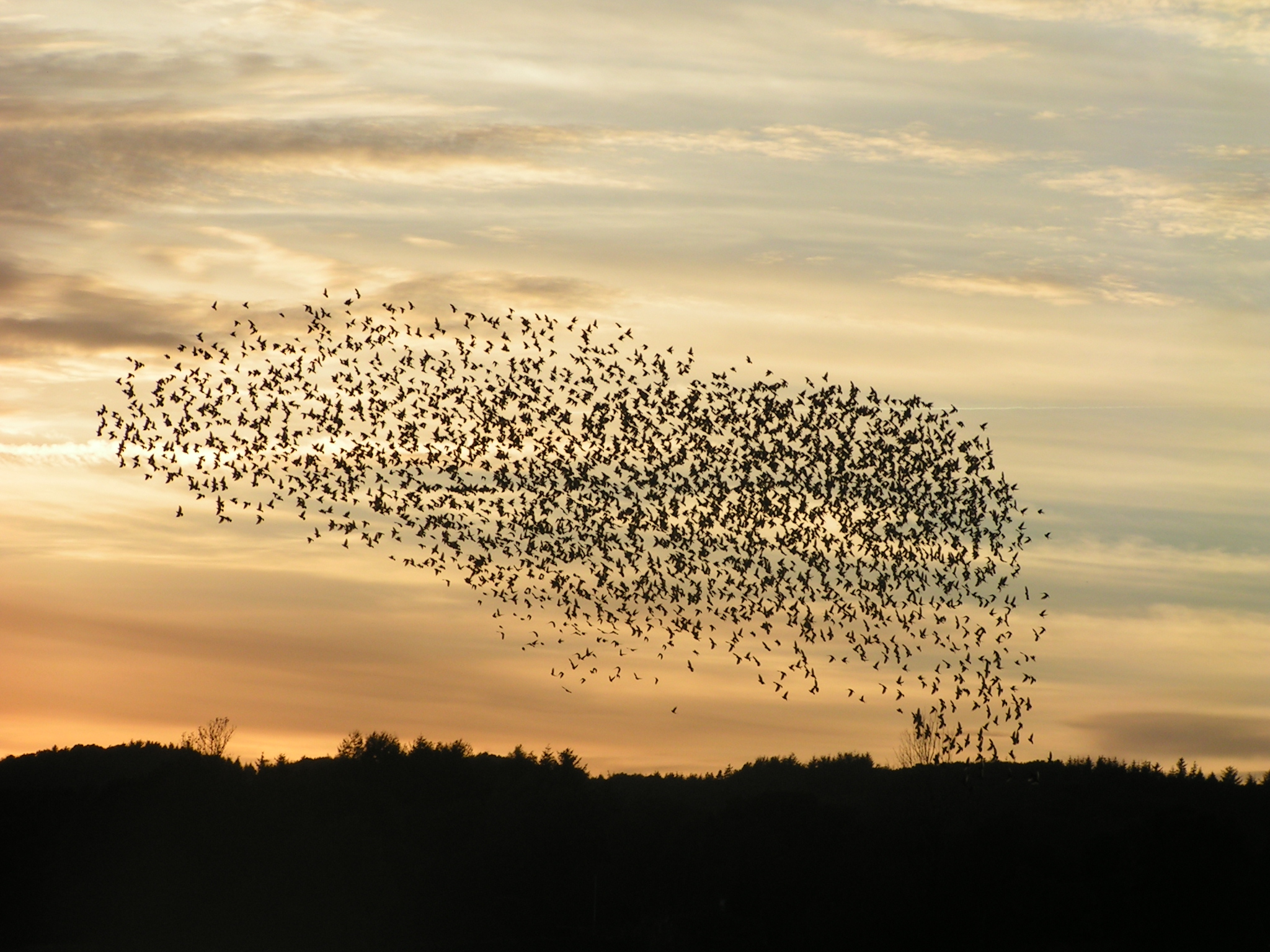
The subject was something I have always found fascinating: the spectacular murmurations of starlings.
At first glance, these formations seem almost impossible. Thousands of birds move together as if they were a single organism, creating shapes that expand, contract, twist, and reform with astonishing precision. Watching them, one could easily imagine some kind of hidden leader directing the movement, or perhaps some mysterious collective intelligence beyond our understanding.
But the reality is much simpler.
As Hannah Fry explained, the rules behind a murmuration are surprisingly straightforward. Each bird only needs to follow a few basic principles: do not get too close to your neighbors, do not drift too far away from them, and adjust your movement to theirs. In short, maintain the right balance between distance and proximity.
Then she added something that stayed with me.
Translated into human terms, she suggested, perhaps those rules simply mean:
“Be a good person.”
The sentence struck me because it transformed what seemed like a purely mathematical phenomenon into something profoundly human.
Since then, I have been wondering whether we might have something to learn from those birds.
Not because starlings are wiser than we are, or because nature is always a moral guide.
But because there is something remarkable about a system in which thousands of individuals can coexist, constantly adjusting themselves to one another, without collapsing into chaos.
As often happens with the most beautiful scientific discoveries, the closer we look, the more they begin to resemble a mirror.
And perhaps the question is not why murmurations work.
Perhaps the more interesting question is:
Why do human societies, despite possessing infinitely greater intelligence, so often fail to achieve the same harmony?
The Mathematics of Harmony
Before turning a natural phenomenon into a social metaphor, it is worth understanding what a murmuration actually is.
For decades, scientists have studied these extraordinary aerial displays, trying to answer a seemingly simple question: how can thousands of individuals move together so coherently without colliding?
At first glance, the problem appears almost impossible. If every bird had to track the position of every other bird, the amount of information required would quickly become unmanageable. A flock of ten birds is simple. A flock of a hundred becomes complicated. A flock of ten thousand should, in theory, collapse under its own complexity.
Yet… it doesn’t.
One of the first people to provide a mathematical framework for collective behavior was computer scientist Craig Reynolds. In 1986, while working on computer animation, Reynolds developed a model called Boids, demonstrating that realistic flocking behavior could emerge from just three simple rules:
- Separation: avoid collisions with nearby individuals.
- Alignment: move in roughly the same direction as your neighbors.
- Cohesion: avoid drifting too far from the group.

Remarkably, no leader was required. Order emerged spontaneously from local interactions.
Years later, a team led by Italian physicist Andrea Cavagna, through the STARFLAG project, studied real starling murmurations using multiple synchronized cameras. Their findings revealed something even more fascinating:
Birds do not monitor the entire flock.
In fact, each bird appears to pay attention to only a small number of neighbors -roughly six or seven individuals -regardless of the overall size of the flock.
More importantly, the interaction is topological rather than metric. Birds do not care whether a neighbor is exactly one meter away or two meters away. They simply maintain relationships with a fixed number of companions.
This seemingly trivial detail turns out to be fundamental, because every bird only needs to process local information, the system becomes infinitely scalable. A flock of one hundred birds and a flock of one hundred thousand birds obey essentially the same rules.
No central authority, no master plan, no bird directing traffic… Just countless individuals constantly making tiny adjustments to preserve the balance between proximity and distance.
Physicists describe this kind of behavior as an example of emergence: complex order arising from simple interactions.
And perhaps this is what makes murmurations so mesmerizing to watch.
We are witnessing thousands of independent beings creating harmony without uniformity.
No two birds occupy the same position.
No two birds perform exactly the same movement.
The flock is not beautiful because every individual is identical, it is beautiful because every individual is different, yet all of them recognize themselves as part of the same system.
And that, perhaps, is the most important detail of all.
Because hidden inside all the mathematics, all the equations, and all the scientific explanations, there is an assumption so obvious that we rarely notice it.
Every bird recognizes the others as members of the same flock.
The Hidden Assumption
At this point, we can finally ask what I believe is the most interesting question of all.
Not how murmurations work.
But rather:
What would happen if birds stopped recognizing one another as birds?
Imagine, for a moment, that starlings suddenly began to distinguish between themselves based on irrelevant differences.

Suppose some birds decided that those with a slightly lighter feather pattern were somehow different.
Or that birds with a small white spot near their wings were no longer considered part of the flock.
Or that those born in a neighboring valley should be treated with suspicion.
The entire system would collapse.
Not because the mathematical rules would stop working, the rules themselves would remain unchanged, but the problem would be much deeper:
The birds would simply stop applying those rules to one another.
They would no longer maintain the right distance and coordinate their movements.
They would no longer preserve the balance between individual freedom and collective harmony.
In other words, they would stop behaving like a flock.
And perhaps this reveals something important about murmurations: their success does not depend only on geometry, speed, or mathematics; it depends on a prior assumption.
An assumption so obvious that it remains invisible.
Every bird automatically considers every other bird as belonging to the same category of beings.
There is no need for a starling to remind itself that another starling is, in fact, a starling.
There is no ideology behind it, no philosophy, no declaration of principles, no international institution, no religion, no constitution:
Recognition comes first; the rules come afterward.
And perhaps this is where the analogy with human beings becomes interesting.
Because, unlike birds, humans have developed an extraordinary ability:
We are capable of inventing categories.
We can divide ourselves by nationality, by religion, by language, by political beliefs, by skin color, by social class, by culture, by sexual orientation, by history, by borders… by almost anything!
This ability is, in many ways, one of the foundations of civilization itself. Categories help us understand the world.
But categories can also become dangerous, because sooner or later, every conflict begins with the same idea:
“Those people are not really like us.”
Before violence comes separation.
Before separation comes dehumanization.
Before dehumanization comes the loss of recognition.
History repeatedly shows that human beings rarely begin by killing one another, they begin by redefining one another:
The neighbor becomes the foreigner, the foreigner becomes the outsider, the outsider becomes the threat.
And once that transformation is complete, the rules that normally regulate coexistence no longer apply.
Perhaps that is why every genocide, every civil war, every ethnic conflict, and every campaign of hatred throughout history has required the same preliminary step.
People who previously belonged to the same “flock” first had to stop recognizing each other as such.
And yet, from a biological perspective, this is profoundly strange.
Because, despite all our differences, there is only one human species.
We are all Homo sapiens.
Which raises another question.
If birds instinctively recognize members of their own species, why do humans so often forget that they are looking at themselves?
We Do Not Love Similarity. We Love Familiarity.
At first glance, one might think that human empathy arises from similarity.

People love people who look like them.
People trust people who share their values.
People cooperate with people who belong to the same culture.
But reality is often much more complicated.
In everyday life, we constantly form emotional bonds with people who are profoundly different from us.
Not because they are identical to us, but because they become part of our lives.
Anthropologists, primatologists, and sociologists have repeatedly observed that social bonds are not built primarily on ideological agreement, but on coexistence.
Among social mammals, including humans, proximity creates familiarity, familiarity creates trust, and trust creates cooperation.
This mechanism is probably much older than civilization itself.
Long before nations, religions, political systems, or even agriculture existed, our ancestors lived together, shared resources, raised children collectively, and depended on one another for survival.
The evolutionary advantages of cooperation gradually shaped emotional mechanisms that still govern our behavior today.
When another individual repeatedly shares our spaces without threatening us, something interesting happens:
We relax.
Curiosity replaces suspicion.
Cooperation becomes more advantageous than conflict.
And over time, simple coexistence can evolve into friendship, affection, loyalty, and even altruism.
Frans de Waal spent decades documenting forms of empathy, reconciliation, cooperation, and reciprocal support among primates. These behaviors are not unique to humans. They are part of the biological heritage of social mammals.
Marcel Mauss, in his famous work The Gift, went even further:
He argued that acts of generosity are not merely expressions of kindness. They create obligations, reinforce trust, establish social hierarchies, and ultimately contribute to the stability of communities.
In other words, altruism itself becomes part of the architecture of society.
Perhaps this is why some of our strongest emotional connections are built with people who are not necessarily similar to us.
The elderly neighbor we greet every morning, the cashier who always smiles, the bus driver we barely know, the waiter in our favorite restaurant, the colleague whose political opinions drive us crazy, but whom we deeply respect.
Or even the postman.
Most of us know very little about the people who deliver our mail.
We may not know their religion or their political beliefs, whom they love, how they vote, or what they think about the world.
And yet, if that familiar figure suddenly disappears after years of seeing them every morning, we feel something.
A small sadness… a sense of absence.
Not because we shared ideas, but because they had become part of the landscape of our lives.
We wanted them to remain where they had always been.
In a strange way, they belonged to our everyday flock.
The same applies to countless interactions that we often overlook.
The Muslim mother bringing her children to the playground; the elderly immigrant feeding pigeons in the park; the family living across the street; the father waiting with us in front of the school.
At first glance, we may notice differences.
Different clothes, different languages, different traditions, different beliefs…
But daily life has a remarkable way of revealing something deeper.
They worry about their children exactly as we do.
They laugh exactly as we do.
They hope to reach the end of the month with dignity exactly as we do.
They seek friendship, affection, recognition, and love exactly as we do.
And perhaps this is one of the great paradoxes of human existence.
We do not necessarily love those who are most similar to us; we love those who become familiar to us.
Perhaps this is also why the deepest bonds in our lives are so often shaped by coexistence. We generally love the members of our family not because they are objectively more similar to us than anyone else, but because we have shared our lives with them. We have grown together, depended on one another, argued, reconciled, celebrated, and suffered together. Familiarity has become affection.
Empathy, in many cases, does not emerge from sameness, it emerges from shared reality.
Which may explain why isolation is so dangerous.
Because when people stop sharing spaces, experiences, and ordinary life, they gradually stop recognizing one another.
And once familiarity disappears, stereotypes quickly rush in to fill the void.
Beneath the Surface, We Are Remarkably Similar
Human beings are extraordinarily good at noticing differences.

In fact, our brains evolved to detect patterns, classify objects, and distinguish one thing from another. This ability has obvious survival advantages. Recognizing edible plants, identifying predators, or distinguishing friend from foe could mean the difference between life and death.
But the same cognitive mechanism that helps us understand the world can also distort our perception of one another.
Because while differences are immediately visible, similarities are often invisible precisely because they are universal.
We notice skin color because not everyone has the same one.
We notice languages because not everyone speaks the same one.
We notice traditions because not everyone celebrates the same holidays.
But we rarely notice the things that every human being shares.
The need to be loved, the desire to feel safe, the fear of losing those we care about, the need for friendship, the search for meaning, the desire to be recognized and appreciated by others, the need to belong, the hope that our children will live better lives than ours, the pain of grief, the joy of laughter, the fear of loneliness.
I can bet that, regardless of your culture, race, political or religious beliefs, reading these words, you will recognize yourself in most of them, because these experiences are so common that we tend to forget how extraordinary they are.
From a biological perspective, the differences between human populations are remarkably small: All living humans belong to the same species and any two human beings on Earth are reproductively compatible.
We share the same basic anatomy, hormonal systems, emotional architecture, developmental stages, and the same life cycle.
We all have the same vulnerability to pain, disease, aging, and death.
And perhaps that last point matters more than we usually admit:
No matter how powerful, rich, educated, religious, progressive, conservative, traditional, or modern we may be, all of us are born helpless, need care, experience loss, and eventually, all of us die.
Our differences are real.
But they exist on top of an immense common foundation.
Culture itself should not be viewed as a problem.
Quite the opposite.
As Yuval Noah Harari and many anthropologists have pointed out, cultural diversity is one of the reasons Homo sapiens became so successful.
Different solutions to similar problems create resilience.
Different traditions preserve knowledge.
Different perspectives generate innovation.
Just as biodiversity strengthens ecosystems, cultural diversity strengthens civilizations.
The problem begins only when differences stop being perceived as variations within the same species and start being interpreted as evidence that some people somehow belong to a different category of humanity.
Because once that happens, we are no longer observing diversity.
We are denying kinship.
And perhaps this is the strangest contradiction of all.
If an alien biologist arrived on Earth tomorrow and examined humanity from a purely scientific perspective, they would almost certainly conclude that Homo sapiens is a remarkably homogeneous species.
Yet we have somehow become experts at magnifying the few things that distinguish us while ignoring the countless things that unite us.
Perhaps birds have an advantage over us.
They do not mistake variation for separation.
Borders, Distance, and Artificial Separation

Having lived in different countries and crossed many borders throughout my life, I have often noticed something that at first seemed paradoxical.
People living near a border frequently have more in common with one another than with people living hundreds of kilometers away within their own countries.
They may speak different languages, carry different passports, vote in different elections…
And yet, they often share the same landscape, the same climate, the same cuisine, similar dialects, similar economic problems, and sometimes even the same families.
Brothers live on opposite sides of a border; cousins grow up under different flags; friends commute daily between countries.
Entire communities continue to interact despite the existence of political divisions.
Reality, as usual, proves to be more complicated than maps.
Political borders are real, and they matter: they define jurisdictions, laws, and institutions.
But human relationships do not always obey straight lines drawn on paper.
In many parts of the world, people living near borders have maintained social, cultural, and family ties for centuries, often surviving wars, changing governments, and shifting national identities.
This observation led me to wonder whether many of the differences we perceive are sometimes amplified by distance itself.
Because distance does something interesting: it reduces familiarity.
And when familiarity decreases, imagination fills the gap.
The less direct contact we have with people, the easier it becomes to replace reality with stereotypes.
The unknown becomes mysterious, the mysterious becomes suspicious.
And suspicion eventually becomes fear.
Gordon Allport‘s Contact Hypothesis proposed precisely this idea: under the right conditions, contact between different groups tends to reduce prejudice rather than increase it.
Perhaps this should not surprise us.
It is difficult to hate someone whose children play with yours, just as it is difficult to demonize someone you greet every morning or maintain abstract prejudices against people who have become part of your daily life.
Which may explain why so many political movements throughout history have invested enormous efforts in separating people.
Physical separation, social segregation, ghettos, walls, propaganda, restrictions on movement.
The interruption of ordinary contact.
Because coexistence has a dangerous tendency from the perspective of those who wish to create enemies:
People who know one another often discover that they are far more similar than they expected.
This does not mean that conflicts are artificial or that differences do not exist.
Interests can collide, resources are limited, and communities can disagree.
Just as waves inside a murmuration continuously create tensions that must be corrected, human societies naturally generate conflicting interests.
Conflict itself is not abnormal.
In fact, it may be inevitable.
The real question is what happens next.
In a flock of birds, these tensions are constantly resolved through countless small adjustments that restore equilibrium:
No wave is allowed to grow indefinitely, no divergence becomes permanent, the flock bends, expands, contracts, and reorganizes itself.
Its beauty lies precisely in this continuous process of correction.
Human societies face the same challenge, but unlike birds, we possess something far more powerful:
We can transform temporary disagreements into permanent identities.
We can turn neighbors into enemies and institutionalize division.
And when that happens, what should have been a simple adjustment becomes a fracture.
Perhaps this is why some of the most destructive conflicts in history did not arise from people being fundamentally different.
They emerged because people who had once recognized each other as part of the same human flock stopped doing so.
And perhaps the greatest tragedy is that many of these divisions are not created by ordinary people themselves:
They are often encouraged, manipulated, amplified, and exploited by those who benefit from conflict.
Because a divided flock is easier to control than a united one.
The Digital World and the Loss of Shared Reality
None of this means that technology is the enemy.

Quite the opposite.
The digital revolution has given humanity something extraordinary:
For the first time in history, billions of people can witness realities that would previously have remained completely invisible.
A natural disaster on the other side of the planet, a war, a humanitarian crisis.
The everyday life of people belonging to cultures we may never physically encounter.
Social media, online communities, and digital communication have dramatically expanded our understanding of how much larger our world is than our immediate surroundings.
In many ways, they have the potential to extend empathy beyond geography.
But potential and reality are not always the same thing.
The problem is not that digital relationships exist; it is that digital relationships often lack one fundamental element that has always characterized human coexistence:
Interdependence.
In real life, other people place limits on us, and we place limits on them.
If a father in front of me at school needs thirty extra seconds to secure his children in the car, I wait.
Not because I agree with his political views, or share the same religion, or because we belong to the same social class.
I wait because I recognize that his needs, at that moment, are no less legitimate than mine.
Tomorrow, I might need the same understanding from somebody else.
Real life constantly forces us to negotiate, compromise, and adjust.
To acknowledge the existence of others.
In a way, daily life obliges us to practice our own human murmuration.
Digital spaces are different:
Online, people can disappear with a click; conversations can be interrupted instantly; opponents can be blocked.
Communities can become increasingly homogeneous.
Algorithms often reward outrage rather than understanding.
And because there are fewer practical consequences to conflict, disagreements that would normally be softened by everyday coexistence can escalate much more easily.
This does not mean that social media create hatred.
Hatred existed long before the internet.
But digital environments sometimes remove the countless small corrections that real life continuously imposes on us.
The result can be a strange paradox:
We are connected to more people than any generation before us, and yet, we may feel increasingly isolated from one another.
Even more concerning is the fact that the digital world risks transforming reality itself into entertainment.
Human suffering becomes content, wars become timelines; tragedies become notifications… people become avatars.
And repeated exposure can gradually empty events of their emotional weight.
What should provoke empathy risks becoming indistinguishable from fiction.
The arrival of artificial intelligence adds another layer of complexity.
For centuries, seeing was believing.
Today, seeing is no longer enough.
Images can be generated, voices replicated, videos fabricated: entire narratives can be manufactured with extraordinary realism.
For the first time in history, humanity is entering an era in which plausibility and reality are no longer the same thing.
Without media literacy, source verification, and critical thinking, we may find ourselves emotionally reacting to events that never happened while becoming indifferent to those that actually did.
But once again, technology itself is not the problem, just as borders are not.
Neither are differences nor institutions.
The real challenge is maintaining our ability to recognize one another as real human beings.
Perhaps digital education should not simply teach people how to use technology, but also how to preserve humanity while using it.
Because if empathy emerges from shared reality, then protecting our relationship with reality may become one of the most important cultural tasks of the twenty-first century.
And perhaps this is why screens should never completely replace faces.
Because no algorithm can reproduce what happens when two human beings look each other in the eyes and silently recognize that they belong to the same flock.
Why Humans Need Institutions
At this point, one might ask an obvious question.
If empathy naturally emerges through coexistence, familiarity, and everyday life, why do we need institutions at all?
After all, birds do not have governments:
Starlings do not hold elections, and pigeons do not draft constitutions, and yet, their murmurations work remarkably well.
The answer, perhaps, lies in scale.
A bird only needs to coordinate with a handful of neighbors.

Human beings, on the other hand, live inside systems of unimaginable complexity.
Our food may come from another continent.
Our economies depend on people we will never meet.
Our technologies connect billions of individuals who do not share the same language, traditions, or histories.
The larger the system becomes, the greater the possibility that different interests will generate waves of tension.
And just like the waves inside a murmuration, those tensions require constant adjustment.
But unlike birds, we cannot rely solely on direct relationships:
No one can personally know eight billion people, or build familiarity with all humanity.
Our emotional architecture evolved for small groups, but civilization forced us to cooperate on a planetary scale.
Institutions are, in many ways, humanity’s answer to this problem.
They are not a substitute for empathy; they are an extension of it.
A kind of collective memory reminding us that people we do not personally know are still entitled to the same protections we expect for ourselves.
Perhaps this is why nearly every civilization has attempted to codify moral principles.
Religions, philosophies, and legal systems did it.
And after the horrors of the Second World War, humanity attempted something unprecedented.
In 1948, the United Nations adopted the Universal Declaration of Human Rights.
Not because human rights had suddenly been invented, but because humanity had just witnessed what happens when people stop recognizing one another as members of the same human flock.
The Declaration represented an extraordinary attempt to institutionalize recognition itself.
To say, in effect:
“Even if you do not know these people, they are still like you.”
“Even if they live far away, they are still human.”
“Even if they speak another language, worship another God, or belong to another culture, they remain members of the same species.”
Of course, institutions are imperfect, and sometimes they fail, or they become instruments of power.
Sometimes they are manipulated by those they were supposed to restrain, history offers countless examples.
But the solution to imperfect institutions is not necessarily the absence of institutions, because a vacuum is rarely neutral.
Without institutions, large societies can fragment into competing groups.
With corrupted institutions, those same groups can be manipulated against one another.
Human civilization therefore lives inside a permanent tension.
Too little structure, and the flock disperses, too much power concentrated in the wrong hands, and the flock can be directed toward disaster.
Perhaps the challenge is not choosing between individuals and institutions.
Perhaps the challenge is ensuring that institutions continuously remind us of something that birds never have to learn.
That the individual standing next to us is not an abstraction, not a category, not a demographic, not a political label.
But another member of the same flock.
In this sense, institutions may be understood as a kind of second-order murmuration.
Not replacing the countless local bonds that hold societies together, but helping to prevent the waves generated by billions of competing interests from turning into collisions.
Birds do not need an ONU, they don’t need a Universal Declaration of Bird Rights either.
They do not need to remind themselves that another bird belongs to the same species.
But humans, apparently, do.
Not because we are worse than birds, but because we are powerful enough to forget.
Conclusion: Learning to Recognize the Flock
When I first listened to Hannah Fry describing the simple rules behind a murmuration, I did not expect that a short scientific video would lead me to reflect on human societies.

And yet, the more I thought about it, the more I realized that perhaps the beauty of a murmuration is not simply that thousands of birds move together.
It is that they do so without requiring uniformity.
No bird needs to become identical to the others, no bird abandons its individuality, no bird occupies the same position.
Harmony does not emerge from sameness; it emerges from coordination.
And coordination itself depends on something even more fundamental:
Recognition.
Perhaps this is the lesson hidden inside those magnificent shapes drawn across the evening sky.
The flock survives not because every bird is the same:
The flock survives because every bird recognizes the others as belonging to the same flock.
Human beings, despite all our intelligence, often struggle with this simple principle.
We have learned how to split the atom, we have reached the Moon, we have connected the planet, we are building artificial intelligence.
And yet we still find ways to forget that the person standing next to us experiences love, fear, grief, hope, loneliness, and joy exactly as we do.
Perhaps our greatest strength and our greatest weakness originate from the same source:
Unlike birds, we can invent categories, create borders, and transform differences into identities, but unlike birds, we can also consciously choose to overcome them.
Because we possess something they do not:
We possess memory, culture, ethics, philosophy, religion, science, institutions.
The ability to learn from history and to deliberately expand the boundaries of our empathy.
Perhaps being a good person does not require loving everyone equally.
Perhaps that would be impossible.
But maybe it requires something much simpler: recognizing humanity before categories, seeing the person before the label, remembering that differences are real, but kinship is deeper.
And perhaps all the great moral systems humanity has created throughout history – religions, philosophies, declarations of rights, and international institutions – are ultimately attempts to remind us of something birds never have to remember:
That the individual flying beside us is not an intruder, an abstraction, an enemy, but just another member of the same flock.
Perhaps we should learn from the birds after all.
Not because they are wiser than we are, but because they never forget who they are flying with.
And perhaps, in the end, Hannah Fry was right:
Maybe maintaining the right distance and the right proximity.
Maybe respecting one another’s space while remaining connected.
Maybe constantly adjusting ourselves to preserve harmony.
Maybe all of that simply means one thing:
Being good to one another.
If you want to know more
- Reynolds, C.W. (1987). Flocks, herds and schools: A distributed behavioral model. ACM SIGGRAPH Computer Graphics, [online] 21(4), pp.25–34. doi:https://doi.org/10.1145/37402.37406..
- Introduces the Boids model, demonstrating how complex collective behavior can emerge from a few simple local rules.
- Ballerini, M., Cabibbo, N., Candelier, R., Cavagna, A., Cisbani, E., Giardina, I., Lecomte, V., Orlandi, A., Parisi, G., Procaccini, A., Viale, M. and Zdravkovic, V. (2008). Interaction ruling animal collective behavior depends on topological rather than metric distance: Evidence from a field study. Proceedings of the National Academy of Sciences, 105(4), pp.1232–1237. doi:https://doi.org/10.1073/pnas.0711437105
- Demonstrates that birds coordinate with a fixed number of neighbors rather than with everyone in the flock, providing one of the scientific foundations of murmuration.
- Marcel Mauss (1925). The Gift: Forms and Functions of Exchange in Archaic Societies.
- Explains how gift-giving and reciprocity create trust, social obligations, and long-term cooperation within communities.
- Émile Durkheim and Halls, W.D. (2008). The division of labor in society. New York: Free Press.
- Explains how increasingly complex societies require institutions and shared norms to maintain social cohesion.
- Allport, G.W. (1954). The Nature of Prejudice. Addison-Wesley.
- Introduces the Contact Hypothesis, showing how direct interaction between different groups reduces prejudice and strengthens mutual understanding.
- Tajfel, H. and Turner, J. (1979). An Integrative Theory of Intergroup Conflict. Oxford University Press eBooks, pp.56–65. doi:https://doi.org/10.1093/oso/9780199269464.003.0005.
- Explains how humans naturally form in-groups and out-groups, providing the psychological basis for social categorization and polarization.
- Frans de Waal (2011). The Age of Empathy. Souvenir Press.
- Demonstrates that empathy, reconciliation, and cooperation are deeply rooted in the evolution of social mammals.
- Harari, Y.N., Purcell, J. and Haim Watzman (2014). Sapiens : a brief history of humankind. London: Harvill Secker.
- Describes how culture, shared narratives, and large-scale cooperation allowed Homo sapiens to build increasingly complex societies.
- United Nations (1948). Universal Declaration of Human Rights.
- Represents the modern attempt to institutionalize universal principles of human dignity and recognition beyond local communities and national borders.
- Granovetter, M.S. (1973). The Strength of Weak Ties. American Journal of Sociology, 78(6), pp.1360–1380. doi:https://doi.org/10.1086/225469.
- Demonstrates that even weak social connections are essential for holding societies together and spreading information.
- Cavagna, A., Cimarelli, A., Giardina, I., Parisi, G., Santagati, R., Stefanini, F. and Viale, M. (2010). Scale-free correlations in starling flocks. Proceedings of the National Academy of Sciences, 107(26), pp.11865–11870. doi:https://doi.org/10.1073/pnas.1005766107.
- Shows how information propagates efficiently through starling flocks, explaining how large-scale coordination emerges from local interactions.
- Putnam, R.D. (2000). Bowling Alone: The Collapse and Revival of American Community. New York: Simon & Schuster.
- Documents the decline of social capital and community participation, emphasizing the importance of everyday social relationships.
- Turkle, S. (2017). Alone Together: Why We Expect More from Technology and Less from Each Other. Basic Books.
- Examines how digital technologies can increase connectivity while simultaneously weakening meaningful face-to-face relationships.
- Haidt, J. (2024). The Anxious Generation. Penguin.
- Investigates the effects of smartphones and social media on social development, empathy, and mental well-being.
- Postman, A. and Postman, N. (2014). Amusing ourselves to death : public discourse in the age of show business. Everest Media.
- Explores how mass media can transform serious public discourse into entertainment, a concept that remains highly relevant in the age of social media.
- Anderson, B. (1983). Imagined Communities: Reflections on the Origin and Spread of Nationalism. London: Verso.
- Explains how nations are socially constructed communities, helping to understand how collective identities can unite or divide people.
- Charles Darwin (1871). The Descent of Man, and Selection in Relation to Sex.
- Establishes the evolutionary continuity between humans and other animals, supporting the idea that social cooperation has biological origins.
- Frans de Waal (2013). The Bonobo and the Atheist: In Search of Humanism Among the Primates. W. W. Norton & Company.
- Explores the evolutionary origins of morality and cooperation, showing that many ethical behaviors predate human civilization.
- Haidt, J. (2012). The Righteous Mind: Why Good People are Divided by Politics and Religion. New York: Vintage Books.
- Examines the psychological foundations of moral and political divisions, explaining why humans naturally form competing social groups.
- Maslow, A.H. (1943). A Theory of Human Motivation. Psychological Review, 50(4), pp.370–396. doi:https://doi.org/10.1037/h0054346.
- Provides a framework for understanding the universal human needs shared across cultures and societies.