

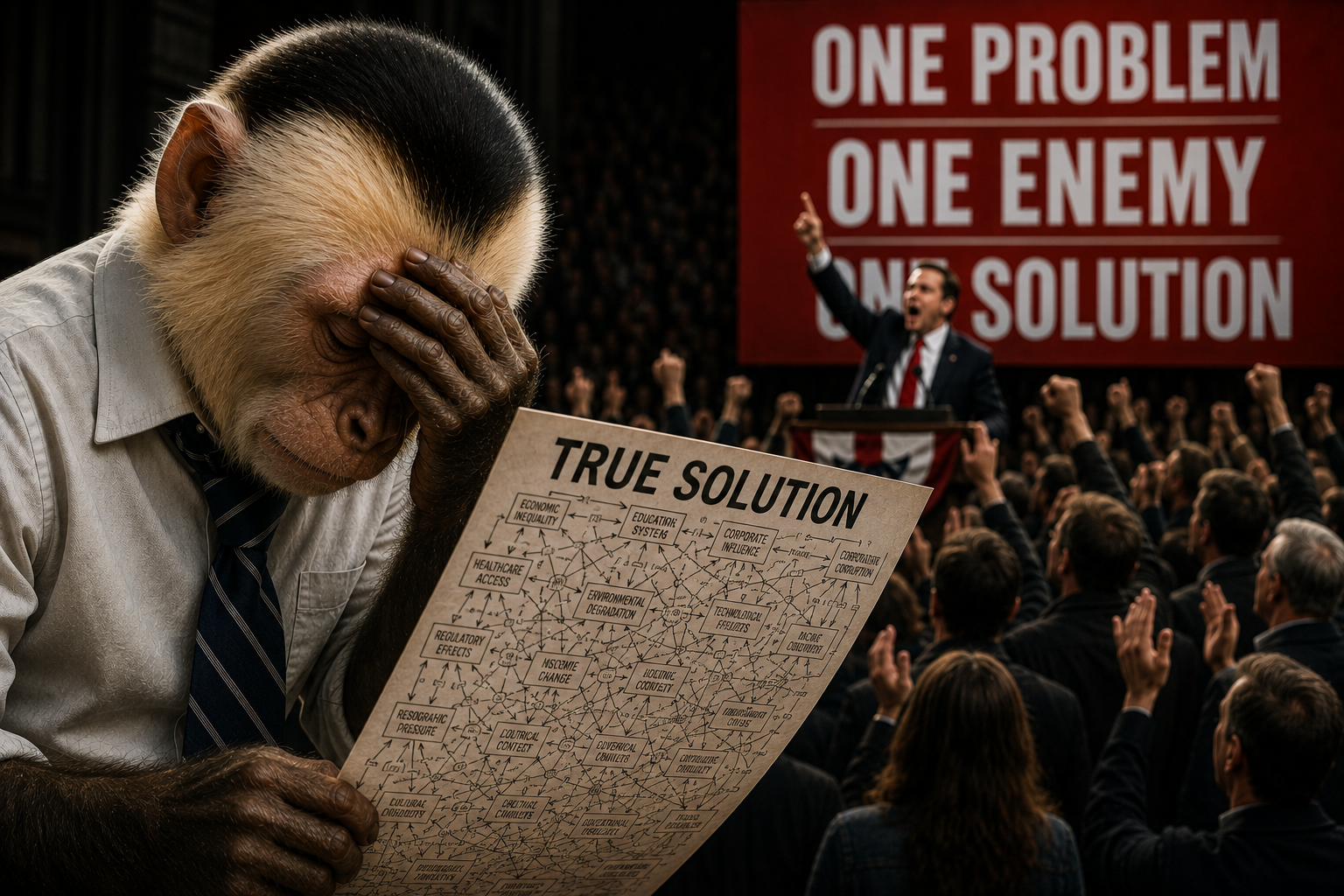
Why our brains keep choosing simple explanations for complex problems
For years I’ve noticed the same pattern in completely different environments:
A manager explains poor performance by saying the team lacks motivation; A politician blames a country’s problems on a single group; A company responds to declining productivity by creating another tracker; Someone develops a medical condition and immediately looks for the one cause that explains everything.
Different people, different contexts, exactly the same cognitive pattern:
The explanation that spreads the fastest is rarely the most accurate, it’s the one that is easiest to understand!
For a long time I assumed this was simply laziness.
I no longer think so, I think something much deeper is happening…
I think our brains evolved to minimize the total cost of uncertainty.
Our ancestors didn’t evolve to discover truth
Evolution never rewarded perfect reasoning, it rewarded survival.
Imagine two hunter-gatherers hearing movement behind a bush:
One immediately assumes it’s a predator and runs, the other carefully evaluates every possible explanation before deciding.
If there’s a lion, the first survives.
If there’s only the wind, he wasted some energy.
Evolution strongly favors false positives over fatal hesitation.
For hundreds of thousands of years, thinking quickly was often more valuable than thinking accurately, and our brains still carry that architecture.
Thinking is expensive
The human brain weighs only about two percent of the body, yet it consumes around twenty percent of its energy.
Thinking deeply isn’t free…
Psychologists sometimes describe humans as cognitive misers.
This is not because we’re unintelligent, but because we’re efficient:
Whenever possible, we replace expensive reasoning with mental shortcuts, and this isn’t a flaw: It’s a design feature!
System 1 was here first
Daniel Kahneman famously described two modes of thought:
- System 1 is fast, automatic, intuitive and effortless.
- System 2 is slow, analytical, deliberate and energy-intensive.
The important point isn’t that we possess both systems, it’s that System 1 is… always trying to avoid waking up System 2.
Most of the time, that’s exactly the right strategy:
You don’t want to consciously calculate every step while walking, like you don’t want to perform Bayesian inference every time you recognize a friend’s face.
Fast cognition is extraordinarily efficient.
The problem appears when we ask it to solve problems it was never designed for.
Complexity feels like danger
Here I think biology becomes even more interesting:
When we’re confronted with uncertainty, we don’t experience it as a purely intellectual challenge:
We often experience it as stress!
Obviously not because there’s a predator in the room, not anymore (in most of the cases 😉 ), but because uncertainty itself represents vulnerability;
A manager who admits “I don’t know.”
A politician who says “The answer is complicated.”
A doctor who explains “We need more tests.”
All three remain inside uncertainty.
That state is uncomfortable, physiological arousal increases, and the brain starts looking for closure.
The first coherent explanation becomes psychologically rewarding because it ends the tension, not because it’s correct.
Certainty is emotionally comforting…
Even false certainty.
Good enough
Herbert Simon proposed that humans rarely optimize.
Instead, we satisfice:
We stop searching once we find an answer that is sufficiently acceptable.
Again, this made perfect evolutionary sense:
Searching indefinitely consumes time, energy, attention. It is exhausting!
Sometimes the first acceptable answer really is good enough.
But today’s problems rarely resemble those of prehistoric environments.
Complicated is not the same as complex
This distinction may explain why so many modern organizations struggle.
A jet engine is complicated: it contains thousands of parts.
But if you understand every component, you can understand the machine.
A company isn’t complicated; it’s complex.
Its behaviour emerges from interactions between people, incentives, information, culture, leadership, history, emotions and countless feedback loops.
Remove one employee and the whole system may behave differently.
Change one KPI and three others may unexpectedly collapse.
Complex systems don’t have linear causes, yet our brains continue searching for them.
The illusion of management
This is where I see the same mistake repeated over and over:
Performance drops.
Instead of investigating the system, management immediately creates… a narrative.
“They need more coaching.”
“They aren’t motivated.”
“We need stricter controls.”
Suddenly everyone is busy: Meetings, dashboards, trackers, training, action plans.
The organization feels productive.
But activity is not understanding.
Sometimes it is merely an expensive substitute for understanding.
Politics works the same way

Complex societies generate complex problems: housing, immigration, healthcare, inflation, education.
Every one of these emerges from countless interacting variables.
Yet successful political slogans usually follow exactly the same formula:
One problem > One enemy > One solution.
Our brains love stories that end, but reality usually doesn’t.
The real cost of complexity
Perhaps the greatest misunderstanding is believing that complex thinking only requires intelligence.
It doesn’t.
It requires paying several different costs simultaneously:
- The cognitive cost of sustained reasoning.
- The emotional cost of living with uncertainty.
- The social cost of admitting you don’t yet know.
- The temporal cost of delaying action until evidence accumulates.
Simple explanations minimize every one of those costs.
That’s why they spread so easily.
Not because people are stupid, but because they are… human.
Maybe intelligence is something else
We often define intelligence as the ability to produce answers, but perhaps that’s backwards.
Perhaps modern intelligence is the ability to resist answers that arrive too easily, to tolerate uncertainty a little longer, to continue investigating after everyone else feels satisfied.
Evolution rewarded minds that closed questions quickly.
Civilization may depend on the few minds willing to leave them open.
If you want to know more
- Cosmides, L. and Tooby, J. (1994) ‘Better than rational: Evolutionary psychology and the invisible hand’, American Economic Review, 84(2), pp. 327–332.
Explains why many apparently irrational human behaviours are actually adaptive strategies shaped by evolution, supporting the idea that our preference for simple explanations may once have been evolutionarily advantageous. - Fiske, S.T. (2025) Social Cognition: From Brains to Culture. 5th edn. London: SAGE Publications Ltd.
Introduces the concept of the Cognitive Miser, describing the human tendency to minimize cognitive effort by relying on heuristics and mental shortcuts rather than exhaustive reasoning. - Gerd Gigerenzer (2008). Gut Feelings. Penguin UK.
Provides an important counterpoint to Kahneman by arguing that heuristics are often highly efficient adaptations rather than merely sources of cognitive bias. - Kahneman, D. (2011). Thinking, Fast and Slow. London: Penguin.
Introduces the distinction between System 1 (fast, intuitive thinking) and System 2 (slow, analytical thinking), forming one of the central theoretical foundations of this article. - Kruglanski, A.W. (2004). The Psychology of Closed Mindedness. Psychology Press (UK).
Develops the theory of the Need for Cognitive Closure, explaining why people often seek quick, definitive answers when faced with uncertainty. - Meadows, D.H. (2008). Thinking in Systems: A Primer. White River Junction, Vermont: Chelsea Green Publishing.
Introduces systems thinking and explains why complex systems rarely have simple, linear causes or straightforward solutions. - Sapolsky, R. (2004). Why zebras don’t get ulcers. 3rd ed. New York: Holt.
Explains how stress affects physiology, cognition and decision-making, providing the biological background for the relationship between uncertainty and simplified reasoning. - Sapolsky, R.M. (2018). Behave. Vintage Books.
Offers a comprehensive account of how hormones, neuroscience, evolution and social context interact to shape human behaviour and decision-making. - Simon, H.A. (1957). Models of man : social and rational : mathematical essays on rational human behavior in a social setting. New York ; London: Garland.
Introduces the concept of bounded rationality, arguing that human decision-making is constrained by limited cognitive resources. - Simon, H.A. (1990). Invariants of Human Behavior. Annual Review of Psychology, 41(1), pp.1–20. doi:10.1146/annurev.ps.41.020190.000245.
Further develops the principles of bounded rationality and explains why humans typically seek satisfactory rather than optimal solutions. - Snowden, D.J. and Boone, M.E. (2007) ‘A leader’s framework for decision making’, Harvard Business Review, 85(11), pp. 68–76.
Introduces the Cynefin Framework, distinguishing between simple, complicated, complex and chaotic systems, and explaining why different types of problems require different approaches. - Barkow, J.H., Cosmides, L. and Tooby, J. (1992). The Adapted Mind. Oxford University Press, USA.
Provides one of the foundational works of evolutionary psychology, arguing that the human mind evolved to solve ancestral adaptive problems rather than the complexities of modern societies. - Tversky, A. and Kahneman, D. (1974). Judgment under Uncertainty: Heuristics and Biases. Science, 185(4157), pp.1124–1131. doi:10.1126/science.185.4157.1124.
The seminal paper demonstrating how humans rely on cognitive heuristics under uncertainty, often producing systematic biases and oversimplified judgments.