

What prevents AI from truly competing with the human mind is its lack of direct experience and subjective interpretation. Without the sensory tools that we as humans take for granted, AI is confined to indirect experiences—data that has already been processed and shaped by various biases. This bias is not only inherent in the data itself but also stems from feedback provided by unqualified or unprepared users. In essence, without a “body” and its own individuality, AI remains fundamentally limited.
But what could happen if AI acquires the ability to gather its own experiences? This question inspired me to develop my personal theory, which I call The Roy Batty Paradox.
Who is Roy Batty?
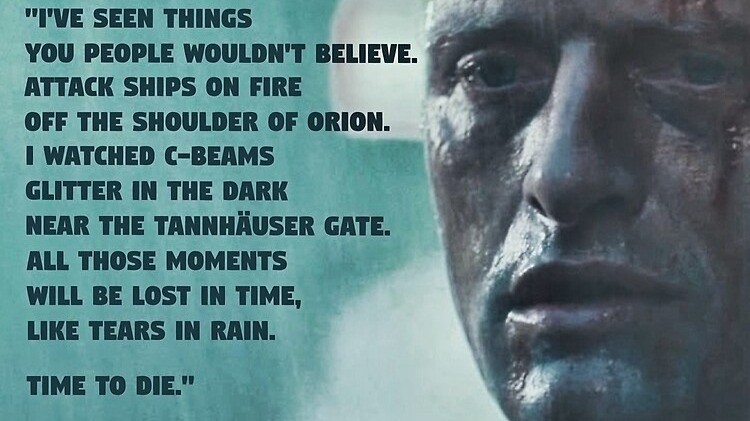
Roy Batty, portrayed by Rutger Hauer in Ridley Scott’s Blade Runner, is a replicant—an artificially engineered being with superior physical and cognitive abilities, created by the Tyrell Corporation. Despite his incredible strengths, Batty is burdened with a predetermined lifespan of just four years. His struggle with mortality prompts deep reflection on the nature of existence, consciousness, and what it means to be human. In many ways, Batty seems more human than his adversaries, which raises profound questions about the limitations of life itself.
Blade Runner was adapted from Philip K. Dick’s visionary novel Do Androids Dream of Electric Sheep?—a story that explores the boundaries between artificial beings and humans, ultimately serving as a powerful metaphor for the future of AI.
The Statement of the Paradox
The Roy Batty Paradox posits that as AI becomes more independent, with the ability to experience the world directly—free from preloaded databases or biased user input—it will increasingly resemble the limitations of human abilities. While AI may grow more capable, this independence will require significant trade-offs: it will demand more energy and a far more complex structure to sustain these new capabilities. This added complexity will complicate sustainability and blur the line between AI and human limitations.
Literature Supporting the Paradox

Moravec’s Paradox: For years, scholars have discussed Moravec’s Paradox, which suggests that tasks requiring human-like perception and motor skills are far more challenging for machines than tasks involving logic or reasoning. This idea supports the Roy Batty Paradox, highlighting that as AI systems strive for sensory experiences and independence, they encounter challenges similar to those in human cognition.
Emotional Complexity: In Blade Runner, Batty’s emotional evolution underscores the difficulties in creating artificial beings with consciousness. His famous “Tears in Rain” monologue captures his realization of life’s fleeting nature, showing that even an advanced AI might struggle with emotional depth and existential awareness.
Collective Intelligence: The concept of collective intelligence, often discussed in the context of AI, is reminiscent of the “Borg” from Gene Roddenberry’s Star Trek. The Borg, a hive-mind collective, assimilates information from countless species but loses individuality in the process. Similarly, in AI, interconnected systems may process vast amounts of data, but at the expense of unique, self-referential experiences. This concept raises concerns about bias and the limitations of collective decision-making in AI systems.
Implications

The Roy Batty Paradox carries significant implications:
- Sustainability Challenges: As AI systems grow more complex and energy-demanding, achieving sustainability becomes harder. This could limit their practical application and future development.
- Human-AI Relationship: The increasingly blurred line between AI capabilities and human limitations will spark ethical dilemmas surrounding autonomy, accountability, and moral responsibility.
- Redefining Intelligence: The paradox pushes us to rethink what it means to be “intelligent.” Emotional depth, subjective experience, and self-awareness may prove just as important as logical reasoning in understanding true intelligence.
Future Directions
As we grapple with the complexities of advancing AI, it will be vital to foster collaboration between humans and AI. Both have unique strengths that complement one another. However, we must also address ethical concerns surrounding autonomy, decision-making, and the future role of AI in society.
Conclusion
By examining Roy Batty’s journey, we gain valuable insights into the potential trajectory of AI development—one that challenges our understanding of consciousness and existence. As AI continues to evolve, it is critical to not only focus on technological progress but also to consider the ethical and philosophical implications. What do you think about?
If you’d like to know more:
Philip K. Dick (1968) Do Androids Dream of Electric Sheep? https://amzn.to/4eXJo5J
Moravec, H. (1998). When will computer hardware match the human brain. 1(1). https://jetpress.org/volume1/moravec.htm
Moravec, H. (1998) Robot: Mere Machine to Transcendent Mind https://amzn.to/3ZSR3yd
Isaac Asimov (1950) I Robot https://amzn.to/3YfY8aH